10 Break-Out Sessions
[timetable id="9" column_title="0" filter_visible="1" filter_multiple="1" event_box_time="0"]

Meet 200 of the world’s brightest young minds.
Exchange ideas with more than 600 senior leaders from business, politics, academia, and civil society.
On top of that, the three best ideas will share a prize fund of CHF 20,000.
As a Leader of Tomorrow, you’ll join a unique global community that extends far beyond the Symposium. Be inspired by world-renowned speakers, challenge your perspectives, and contribute to the conversations shaping tomorrow.
Your submission has two parts
The Solution Brief is the core of your submission. In no more than 1,000 words, across four sections, you identify a real problem, back it with evidence, propose a partnership that could solve it, and show how it would work. It’s assessed anonymously, the strength of your argument and evidence is what counts, not who wrote it.
The Video Explainer is your second submission. Imagine you run into your dream speaker at the Symposium and pitch them your idea — you have three minutes.
What could we solve, if we could agree?
Cooperation increasingly comes with terms, and those terms determine what gets built and what is left undone. They also govern the clock: what was once a decision is now a negotiation. Somewhere, a solvable problem remains unsolved because the parties cannot agree.
Identify such a problem and propose a novel arrangement that would make solving it more effective.
Choose a case you understand from the inside. Show us what would be built or unlocked, and the evidence it works. Then set out who would have to be involved, on what basis they would come together, and why this has not yet happened.
DEADLINE: 1 FEBRUARY 2027
For any unanswered questions please contact us via e-mail at [email protected]
We expect a professional, creative and thought-provoking Solution Brief. Be bold, unconventional and distinctive in addressing the competition question. The use of AI tools is permitted and must be declared; the judging focuses on originality and the strength of your own thinking.
| Form | Solution Brief (max. 1000 words using our template) + 3-minute Video-Explainer |
| Language | English |
| Deadline | 1 February 2027, 11:59 p.m. last time zone (UTC-12) |
| Anonymity | In the first round, your Solution Brief is assessed anonymously, so that only the quality of the idea decides. Before you submit, check that your name, e-mail address and university do not appear in the brief. You may describe the field, industry or region your idea comes from. The jury sees your Video Explainer only in the second round, to confirm that the idea is yours. |
| Individuality | Individual work expected, no group work allowed. The solution brief must be written exclusively for this contest. The idea must be the author’s own. |
| Citation | All sources must be cited and referred to the respective part in the essay. All contributions will be tested for plagiarism. Any auxiliary aids (AI, proofreading, layout/graphics services, writing and translation programs, etc.) are to be listed. All auxiliary aids and resources used must be fully and correctly cited. Failure to acknowledge or reference any aid will result in disqualification. Transparency and academic integrity are mandatory. |
| Template | Download Template for the Solution Brief & Watch the Instruction Video |
Meet our student representatives to learn how you can qualify for a participation in the 56th St. Gallen Symposium. We will have physical presentations at your university again as well as regular webinars to answer your questions! Roadshow will be shared soon.
Who can compete for a participation as a Leader of Tomorrow at the St. Gallen Symposium?
Students enrolled at a regular university, who are matriculated in a master or postgraduate programme.
What is the St. Gallen Global Ideas Competition?
The St. Gallen Global Ideas Competition is a global student competition, offering students who study at graduate or postgraduate level around the world the opportunity to apply for participation at the St. Gallen Symposium.
What is the Knowledge Pool?
The Knowledge Pool is a group of Leaders of Tomorrow with a strong affiliation to topics of relevance to the St. Gallen Symposium. They show outstanding track records in the particular fields they work or study. They are hand-selected by the International Students’ Committee. It is not possible to apply for membership in the Knowledge Pool.
How much does it cost to participate?
The participation in the symposium is free for all Leaders of Tomorrow. Moreover, expenses for travel, board and lodging are covered by the ISC. However, we recommend bringing a small amount of pocket money for your convenience.
Why is it no longer called the Global Essay Competition?
The competition has run since 1989 and the essay served it well. But we want to assess how you think, not only how you write and a written submission alone in times of AI assistants can no longer show us that. The Solution Brief keeps the analytical rigour the competition has always demanded, in a sharper format. The Video Explainer lets you show us the thinking behind the idea in your own words. The name reflects what we are actually looking for: your idea
Who is eligible for the 56th St. Gallen Symposium?
Students enrolled at a regular university, who are matriculated in a graduate or postgraduate programme as of 1 February 2027, from any field of study, born in 1997 or later.
What is a “regular university”?
In the context of the Global Ideas Competition, a regular university is defined as an institution of higher education that also conducts research and offers at least one PhD programme. Exceptions are possible and are granted on a case-by-case basis.
Can Bachelor students participate?
Unfortunately, students on bachelor level do not fulfil the eligibility criteria and therefore cannot enter the competition. There is no other way to apply for participation and we, therefore, encourage all students to join the competition once they pursue with their studies at a graduate level. You may, however, be eligible if the level of study in your current year is equivalent to international graduate level (i.e. in the 4th year of your Bachelor Degree with honours) which must be confirmed in writing by your university.
Can teams participate?
Only individual submissions are allowed as we can only grant participation to one contender per contribution.
How long should the Solution Brief be?
Maximum 1,000 words across all four sections. There is no minimum. Your References, Auxiliary Aids Directory and optional Evidence Annex do not count toward the limit. Please state your exact word count in the document, and remember that your name must not appear anywhere in it.
What is a Solution Brief?
A structured, evidence-based proposal in four sections: a Summary of your idea, an Evidence & Analysis section diagnosing the problem, your Proposal and what makes it original, and an Implementation Path. It is not an essay and not a pitch deck, it is the document you would hand to a decision-maker who has ten minutes. The template guides you through each section.
What should my Video Explainer look like?
Imagine you run into your dream speaker at the St. Gallen Symposium and have three minutes to pitch them your idea. Speak into your camera in your own words. No slides, no screen share, no reading from a script, notes are fine. Maximum three minutes; there is no minimum.
What if I don’t have good recording equipment?
A phone camera in a quiet room is entirely sufficient. We assess your thinking, not your production values or your fluency in English. Non-native speakers are not disadvantaged.
Can I use AI?
Yes and you must declare it. List every auxiliary aid you used in your Auxiliary Aids Directory: which tool, how you used it, and which parts of the submission it affected. Using these tools is permitted and expected. Failing to declare them is not, and an undeclared aid discovered during review leads to disqualification.
Do I have to quote my sources?
All sources must be quoted and all Solution Briefs are scanned for plagiarism. You must refer each source to the respective text passage. Please note that plagiarism is a serious offense and that we reserve the right to take further steps in case of deliberate fraud. Self-plagiarism will also result in disqualification, as the work has to be written exclusively for the Global Ideas Competition of the St. Gallen Symposium. Furthermore any auxiliary aids (AI, translation service, layout/graphics services, writing and translation programs, etc.) are to be listed in an auxiliary aids directory as shown below:
| Aid | Usage | Affected parts |
| Private proofreading | Spell check | Complete brief |
| DeepL | Translation of text passage | Section 2 |
| Endnote | Compilation of the literature index | References |
| ChatGPT | Identifying counter-arguments; all text written by me | Section 3 |
How to cite ChatGPT and other Large Language Models used as part of the argumentation?
Example 1: Direct quote When prompted with “Write a formal invitation text for a lecture about endurance sports in old age,” ChatGPT generated the following text: “Dear Sir or Madam, We are pleased to invite you to an enlightening lecture titled ‘Endurance Sports in Old Age: Benefits and Best Practices’ […]” (OpenAI, 2025).
Example 2: Paraphrased text According to ChatGPT’s response to the prompt “What are the most important virtues today?”, empathy, responsibility, honesty, and integrity are currently considered particularly important and desirable in our society (OpenAI, 2025).
Reference
OpenAI. (2026). ChatGPT (Mar 14 version) [Large language model]. https://chat.openai.com/chat
You may also put the full text of long responses from ChatGPT in an appendix of your essay, so the jury has access to the exact text that was generated.
Can I have a look at previous Winner Essays?
Yes, you can find past winners and publications here. Please note that submissions up to and including 2026 were written in the previous essay format.
What file formats are accepted?
Solution Brief: doc, docx or pdf, with text that can be copied (no document protection).
Video Explainer: MP4 or MOV, or a direct link to YouTube or Vimeo (unlisted is fine), minimum 720p.
What documents do I need to submit?
-Your Solution Brief, with no indication of your name in the file, the file name or the file metadata
-Your Video Explainer (max. 3 minutes)
-A copy of your passport or another official government ID (not a driver’s licence), to verify your age
-A confirmation of matriculation from your university, confirming your graduate or postgraduate status as of 1 February 2027
-A short abstract (200–300 words), entered directly in the registration form
What happens after I submitted my application?
The ISC verifies your eligibility and checks all submitted documents for completeness and readability. Given the volume of submissions we receive, our response may take some time, thank you for your patience.
In the first round, the jury assesses Solution Briefs anonymously. Video Explainers are reviewed in the second round. If you are selected in the top 100, you qualify as a Leader of Tomorrow for an expenses-paid participation in the 56th St. Gallen Symposium. Results are announced by e-mail by mid-March 2027.
Three awardees share a total prize of CHF 20,000, and the very best competitors will present their ideas on the main stage at the Symposium
Who’s in the jury?
The Award Jury consists of leading executives, journalists and professors from all around the world. The Academic Jury is composed of young top academics from the University of St. Gallen and the ETH Zurich.
When will the results be announced?
The jury’s decision will be announced by mid-March at the latest.
How do the travel arrangements work?
The organizing committee will get in touch with you prior to the symposium to discuss your itinerary and to book your travel.
Can the organising committee help me get a visa?
All Leaders of Tomorrow are self-responsible to get a visa. However, we will inform the applicable Swiss embassy about the invitation and will provide you with the necessary documents. Should a problem arise anyway, we are happy to help. Expenses for visa application are borne by the Leaders of Tomorrow themselves.
Where am I accommodated during the symposium?
All Leaders of Tomorrow are accommodated at private student flats across the city. Please give us an early notice should you have any special requirements (e.g. female flatmates only).
What transport is provided?
We book flights or train tickets and provide shuttle service from and to the airport. Furthermore, all Leaders of Tomorrow receive a free ticket for the public transport in St. Gallen during the week of the symposium.
How much money do I need?
We recommend bringing some pocket money (CHF 100–200) for your convenience. Please note that depending on your time of arrival and departure, some meals might not be covered.
Can disabled people participate as well?
Yes, of course. Most of the symposium sites are wheelchair-accessible and we are more than happy to help where we can. Although our ability to provide personal assistance is very limited, we do our best to provide the necessary services.
Is there any touristic programme and do I have time for sightseeing?
During the symposium there will be no time for sightseeing. However, we may offer selected touristic programmes a day before or after the symposium. These days can, of course, also be used for individual sightseeing. Nearby sites include the old town of St. Gallen, the lake Constance and the nearby mountains.
Can I extend my stay in Switzerland?
Yes, upon request we can move your return flight to a date of your choice. If the new flight is more expensive, we may ask you to cover the price difference. Please note that we are unable to provide any services such as accommodation or transportation after the end of the symposium week.
Can I bring a spouse?
Unfortunately, we cannot provide any services such as travel, room, board or symposium access to any additional person.
Out of approximately 1,000 annual submissions from graduate and postgraduate students around the world, the jury selects three winners every year. Meet our past winners and read their contributions. Submissions up to and including 2026 were written in the previous essay format.
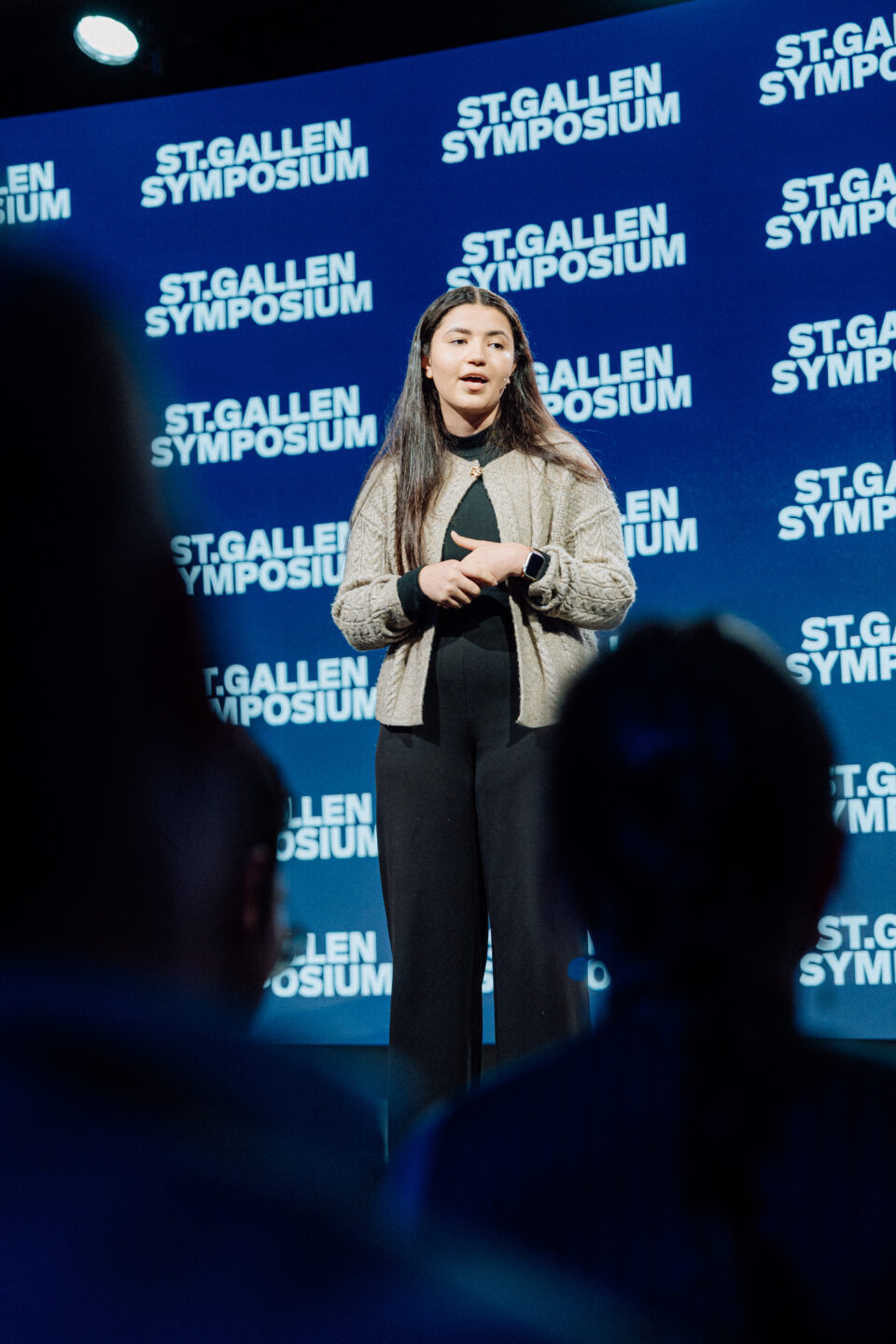
1st place
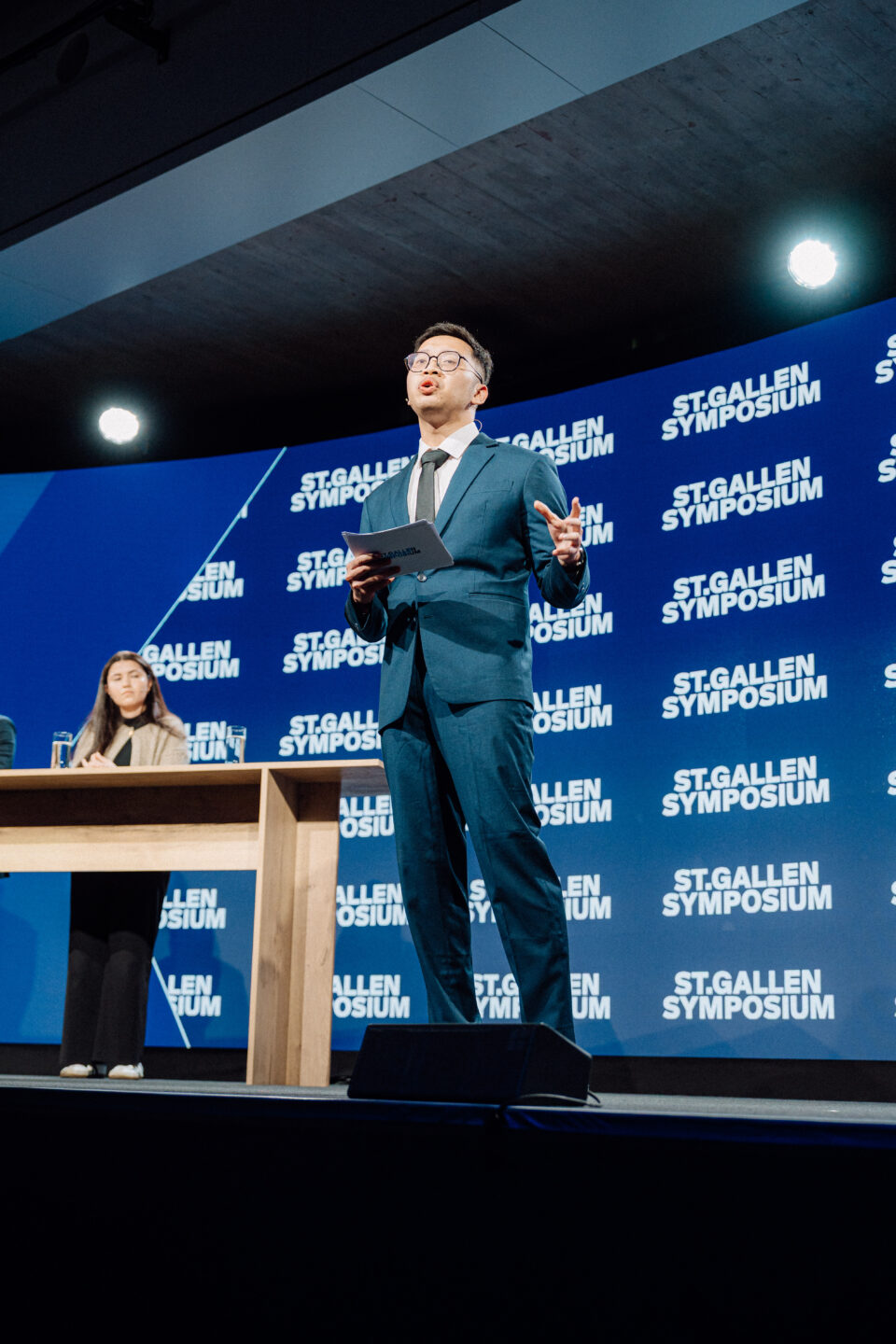
2nd place
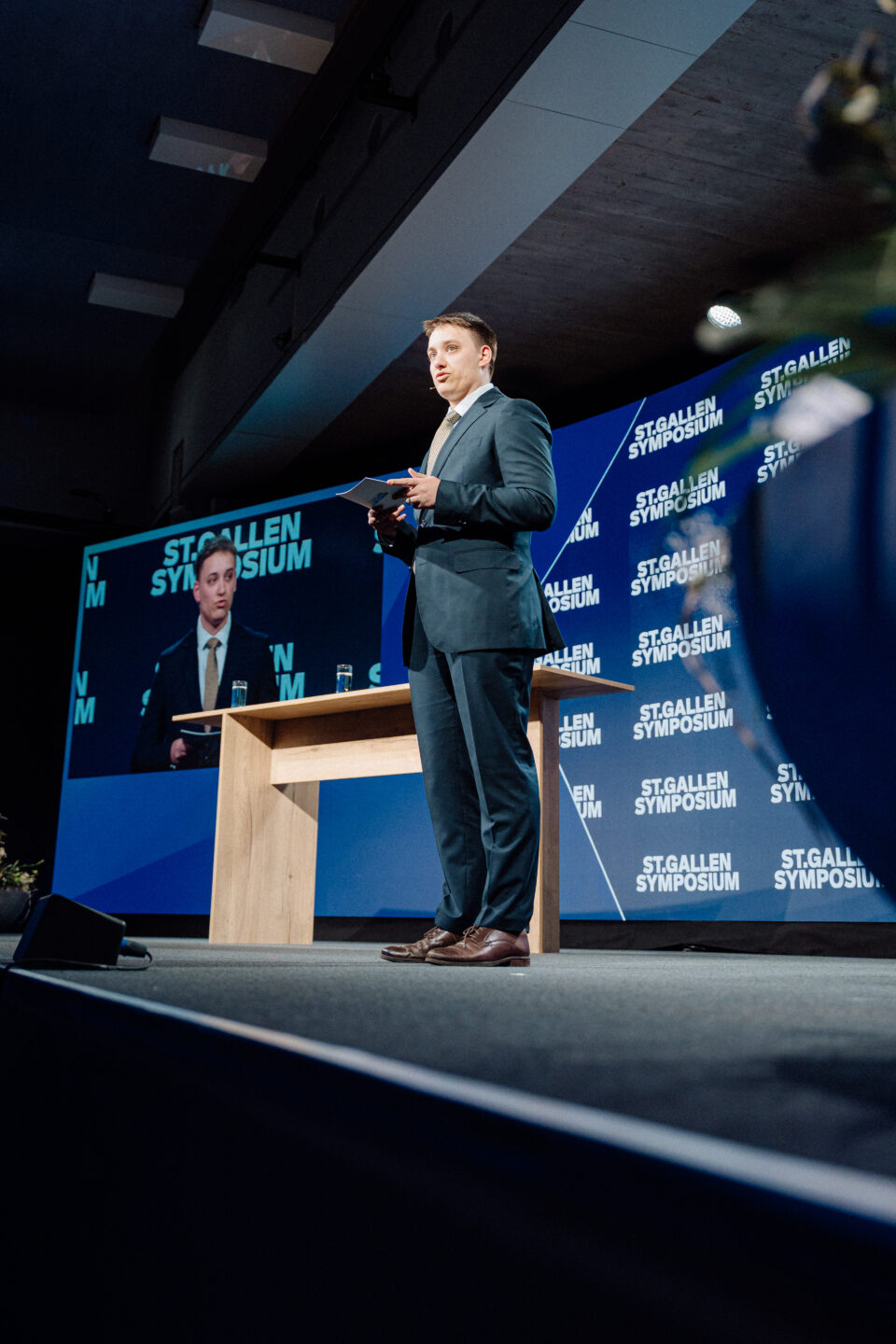
3rd place
Disruption in Tech + Politics + Demography: What happens when they collide?
Pick a case where at least two of these forces meet, and propose a bold idea to maximize the benefits while minimizing the risks over the long term.

1st place

2nd place

3rd place
The 2025 Global Essay Competition explored the shifting centers of global power, particularly the emergence of dynamic hubs across Asia, Africa, and Latin America. As nations in these regions evolve into influential centers of economic, political, technological, societal, cultural, and demographic transformation, participants were invited to address the critical risks and opportunities arising from this global rebalancing. Responding to this year’s question: Global power is shifting. What’s your innovative idea to address a related risk or opportunity?; the top 25 submissions demonstrate how the next generation of leaders is reimagining the foundations of global cooperation, proposing ambitious, regionally grounded innovations that challenge existing institutional assumptions and call for more inclusive, distributed, and future-ready systems.

1st place

2nd place

3rd place
Scarcity generally refers to a situation where human needs exceed available resources. The 2024 Global Essay Competition invites young leaders worldwide to focus on a specific contemporary or future challenge related to scarcity and propose an innovative way to address it. They were asked to be creative in thinking about proposed solutions: do we need to strive for more and find ways to boost the availability of the resource in question? Or does it focus on ways to thrive with less and thus rethink our needs and demand? Participants were free in choosing which scarce resource they focus on: examples include – but are NOT limited to – human labour, capital, natural resources, or intangibles like time, creativity, or care. The challenge is to be bold and precise in describing a contemporary or future challenge of scarcity and the specific kind of resources they focus on, to offer a concrete and actionable idea of how we should confront it.

1st place

2nd place

3rd place
The best or worst legacy from previous generations: How to preserve or replace it?
A great deal of our lives is influenced by when we were born. As those currently alive, we have inherited the world which previous and older generations have built. We owe a great deal to the efforts of our forebears, but we also inherit problematic legacies.

1st place

2nd place

3rd place
Collaborative Advantage: what should be written into a new intergenerational contract?
The idea of a “generational contract” embodies the principles that younger and older generations rely on each other to provide mutual support across different stages of their lives. Inclusive education systems, sustainable welfare states and meaningful environmental action are some of many challenges requiring a cross-generational collaborative effort. Yet, with the climate crisis, rapid technological change and societal aging in many countries, the generational contract and notions of intergenerational fairness have been challenged. Members of the younger generation are raising their voices as they reflect on how their futures are being compromised by current decision-makers.
What’s your specific and actionable idea that should be written into a new generational contract? Choose an area where you see evidence that intergenerational fairness is – or, going forward, will be – challenged and where the generational contract needs to be rewritten. Potential areas include, but are not limited to, business strategy and the economy, inclusive governance and education, the welfare state and health care, environmental sustainability, or the world of work. Describe your problem and offer concrete and practical proposals how inter-generational fairness can be restored or reinvented. Explain your idea’s impact for the future.

1st place

2nd place

3rd place
A Matter of Trust: How Can Trust be Repaired When It’s Lost?
In recent years, we have seen many reports about “trust crises” in the realms of politics, health, business, technology, science, and media. Political and corporate scandals, mass protests, and deteriorating trust indicators in global perception surveys support this diagnosis. As a result, senior leaders in many of these sectors publicly aspire to “rebuild trust” in their decisions, products, or institutions. What would be your advice to them?
Choose an area in one of the above-mentioned sectors where you see evidence that citizens’, consumers’, regulators’, employees’ or other stakeholders’ trust has been lost. Describe your example of an apparent loss of trust; offer concrete and practical proposals on repairing damaged trust. Describe your idea’s impact for the future.

Freedom Revisited: Which aspects of freedom need to be defended, or recalibrated, to meet the challenges of our time?
Domestically and on the international stage, values of individual, economic, and political freedom are subject to critical inquiry or outright attack. Diverse phenomena such as populism, global power shifts, climate change, the digital revolution, and global migration call for a reflection on the value of freedom for the way we live, do business, and organize politically in the years ahead. While some call for a defence of established freedoms, others call for recalibration of our concept of freedom, or the balance we strike between freedom and other values, such as equality, sustainability, and security. Where do you stand in this debate? Choose one of the following positions as you develop your essay:
In defence of freedom: Choose an area in the realm of business, economics, politics, or civil society where current concepts of freedom are under pressure and where they need to be defended. Describe the problem and offer a concrete and practical proposition of how established concepts of freedom should – and can be – defended. Describe its impact for the future.
In defence of recalibrating freedom: Choose an area in the realms of business, economics, politics or civil society where current concepts of freedom are unsuitable for the challenges we face and where they need to be recalibrated. Describe the problem and offer a concrete and practical proposition of how established concepts of freedom should and can be recalibrated. Describe its impact for the future.

1st place

2nd place

3rd place
Is it as good as it gets? – What approach would you suggest to change the current purpose of capital?
Political volatility, environmental issues, precarious labour markets, technological monopolies, managerial and investment short-termism are only a few challenges we face. The time has come to counter excessive short-termism and start doing business as unusual. Think about the status quo and its implications. What would be an idea to change it? Develop projects or actions you would trust in to bring new and expanded purposes to capital and aim for a long-term positive impact. In your essay you should consider how the use of capital (financial, human, social,…) can solve complex challenges and address substantial changes, be it by individuals, civil society, businesses or governments. Your idea must inspire leaders worldwide to take on responsibility and put it into practice. Be bold and develop a truly impactful concept to win our prestigious award.
Essay Question:
Robots are coming for your job. How do you augment yourself to stay economically relevant?
Author Yuval Noah Harari claims that the rapid progress of artificial intelligence technology will render the human species economically useless within decades. Imagine a world in which humans fight back, harnessing AI and other technologies to stay economically indispensable – and, ultimately, competitive against the computers. Describe the job you aspire to in the future, how it will potentially be influenced by AI, and how you would augment yourself technologically if necessary to prevail in your chosen career.
Essay Question:
Breaking the status quo – What’s YOUR disruptive idea?
The notion of disruption captures today’s innovation zeitgeist. Nowadays, it seems everyone claims to be a disruptor – particularly young people with an entrepreneurial mindset. Let’s think beyond disruptive innovation in management and look at disruption more generally as something that breaks the status quo – be it in business, politics, science, or society. Pick the one of these four fields you are most passionate about, identify a problem of greater magnitude and come up with a disruptive idea to solve it. Your idea must aspire to inspire top-notch leaders worldwide. Do not free ride on the buzzword “disruption” but rather be bold and develop a truly novel and radical concept to win our prestigious award.
Essay Questions:
Think about unconventional ideas, undiscovered trends or peripheral signals that may turn into ground-breaking changes for societies. Present one idea which is not on the radar of current leaders yet but will change the game in business, politics or civil society – the best ones will be put to the test by the global audience of the St. Gallen Symposium.
Although small states lead the global rankings in international benchmark studies on competitiveness, innovation and wealth, they are often politically marginalised. Explore a common agenda for small and prosperous countries and identify one joint project that would increase the relevance of small states on the global stage. Go beyond politics and diplomacy by also including economic and civil players.
Human history shows that the world has been ruled by tiny but superior groups of people. It is the elites who have been controlling societies and the allocation of resources. Given the rise of inequality, a devastating level of famine that still exists, ubiquitous corrupt systems of government, limited access to education for the underprivileged, to name just a few of the world’s greatest problems, elites are challenged to redefine their roles and agenda settings. Share your thoughts on how elites are supposed to emerge and transform in the 21st century.
Essay Questions:
The presumption of an altruistic relation between generations and its positive effect on the economic well-being of societies is illusionary. Welfare states have widened fiscal gaps to an irreparable extent for the next generations. When aspiring to a sustainable welfare system, how should intergenerational claims balance without having to rely on selflessness?
Let’s be frank: The generational contract has failed everywhere – but for different reasons. Exuberant public debts, zooming healthcare costs, unequal distribution of wealth, loss of ethical and moral anchors, loss of trust in existing institutions: each state is facing a unique set of problems. Briefly describe the situation in your country and propose a generational contract defining mutual responsibilities on an economic and social level.
Highly educated and ambitious, yet unemployed. A whole generation of young is entering the labour market with little prospect of success. The implications go way beyond individual tragedies as economies with lasting high levels of youth unemployment risk social instability. Present new solutions on how we can overcome this crisis.
Slogans like “rent is the new own” or Botsmann and Rogers’s “what’s mine is yours” (HarperBusiness, 2010) mark the trend of shared economy. Although not a new economic phenomenon per se, particularly the Millennials are embracing this attitude towards doing business where they value access over ownership. The trend is gaining global mainstream acceptance which is resulting in a lasting impact on economic performance. Discuss the future of shared economy, its overall implications and the dynamics between supply and demand.
Essay Questions:
The competitors must choose from one of four competition questions, which refer to the four topic clusters “Putting incentives right”, “Coping with institutions”, “Against the current – courageous people” and “Management of excellence”
How come that both in the corporate world and in politics, responsible courage (e.g. whistleblowing, courage to disagree with current paradigms, etc.) is hardly ever rewarded? Where the big decisions for the future are taken, anxiety, conformity and despondence prevail. How can this be changed?
Institutions of all kinds shape our behaviour – be it economic, political or social behaviour. How should institutions be designed in order to foster a sustainable economic and social development?
Observers lament that younger generations, as individualistic as they are, tend to settle for a highly streamlined social and economic world that does not ask for big decisions or unconventional thinking. Please share your opinion on this observation and explain why you agree or disagree. Please use examples that support your arguments.
New insights can only flourish within a culture of dialogue in different opinions. No assumptions should be taken for granted nor should there be any unquestioned truth. However, most people (decision makers, managers, students, etc.) often fail to deal constructively with conflicting opinions. How can companies encourage their employees to build a healthy attitude towards unconventional thinking and acting?
Essay Questions:
Detecting Risks
Risk Aversion
Emerging Risks
Managing Risk
There is often a disconnect between taking risks and bearing the burden of the consequences of doing so (e.g. risk taking in investment banking). Who should bear the consequences of negligent risk taking and why? How can healthy risk taking be fostered in wealthy societies?
Essay Questions:
Entrepreneurship between environmental risks and opportunities: What does it take to succeed?
What makes an entrepreneur an “agent of change”?
Changing of the guard: Who are the new entrepreneurs?
Corporate entrepreneurship within large companies: a concept for the future or a mere pie in the sky?